AI / LLMOps2025
RustSensei
Local AI assistant to learn Rust in French, with LoRA fine-tuning and RAG over the official documentation.
LLMLoRARAGllama.cppQwenPythonRustFine-tuning
Concept & Approach
RustSensei is a teaching-oriented AI assistant designed to teach the Rust language in French. The goal: make learning Rust accessible with a 100% local and free tool.
Why this project:
- Rust is known to be hard to learn (ownership, borrowing, lifetimes)
- Few learning resources in French
- General-purpose LLMs lack precision on advanced Rust concepts
- Need for a tool that works offline for confidentiality
Local-First approach:
- No dependency on an external API
- Works fully offline once installed
- Optimized for Apple Silicon (Metal/MPS)
- User data never transmitted
Current version: v1.0 as a CLI
A React + TypeScript + Tailwind web interface is under development for v2.
v1.0 CLI
Version
French
Language
100% Local
Mode
Beginners
Target
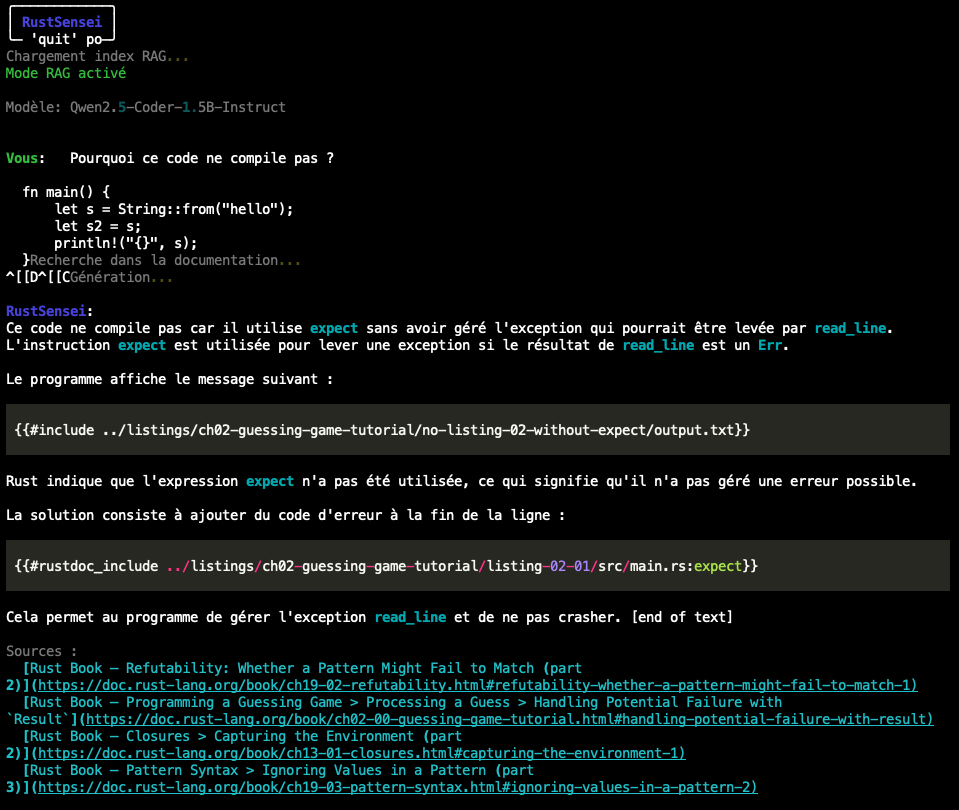
CLI v1: compilation error analysis with RAG sources (Rust Book)
Technical Architecture
Tech stack optimized for fast local inference with custom fine-tuning.
Base model:
- Qwen2.5-Coder-1.5B-Instruct as the foundation
- Compact model (1.5B parameters) for fast inference
- Specialized in code generation
LoRA fine-tuning:
- Rank 8 for a good quality/size trade-off
- Dataset of 49 Rust examples in French
- Focus on fundamental concepts (structs, enums, ownership, borrowing)
- Lightweight adapter (~10MB) instead of retraining the whole model
Inference:
- llama.cpp for optimized execution
- Metal/MPS support for Apple Silicon GPUs
- GGUF format for quantized models
- Lower latency thanks to GPU acceleration
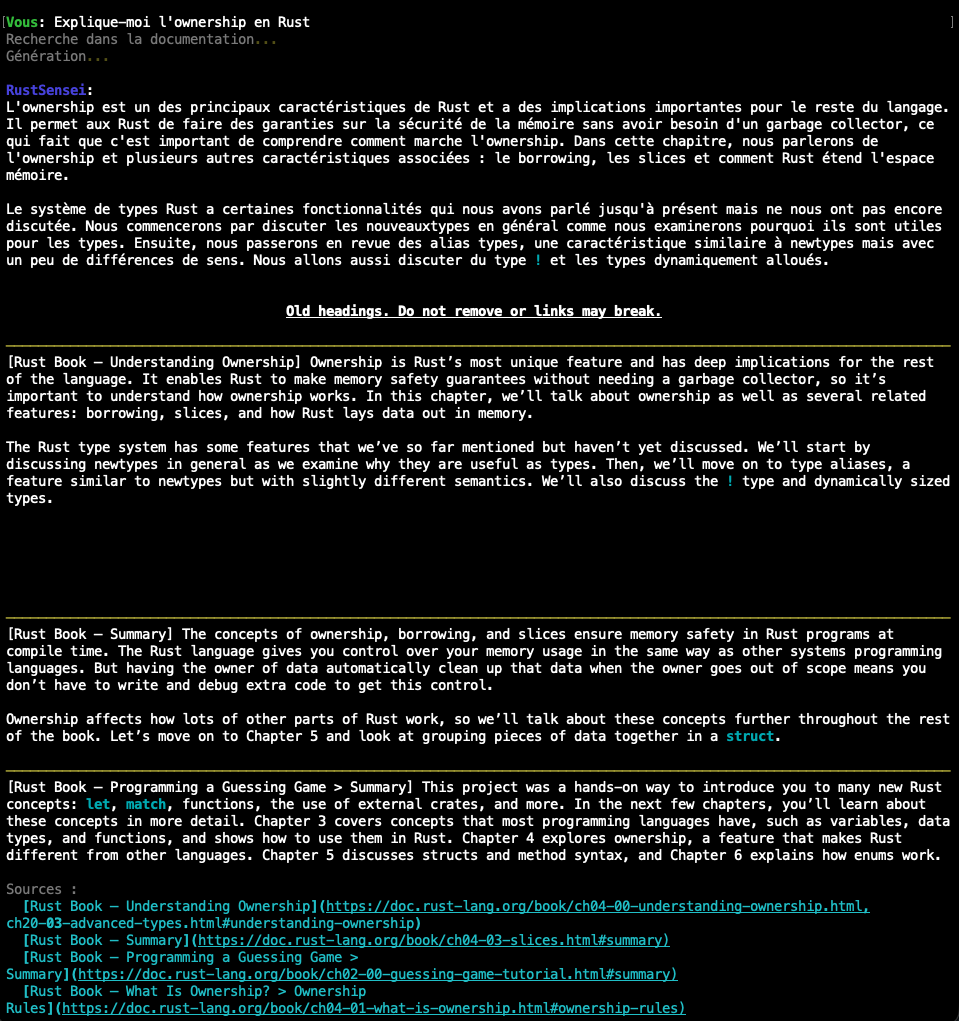
RAG (Retrieval-Augmented Generation):
- Indexing of the official Rust documentation
- Answers enriched with reliable sources
- +10% improvement on the benchmarks
Qwen2.5-1.5B
Base
LoRA r8
Fine-tuning
llama.cpp
Inference
+10%
RAG boost
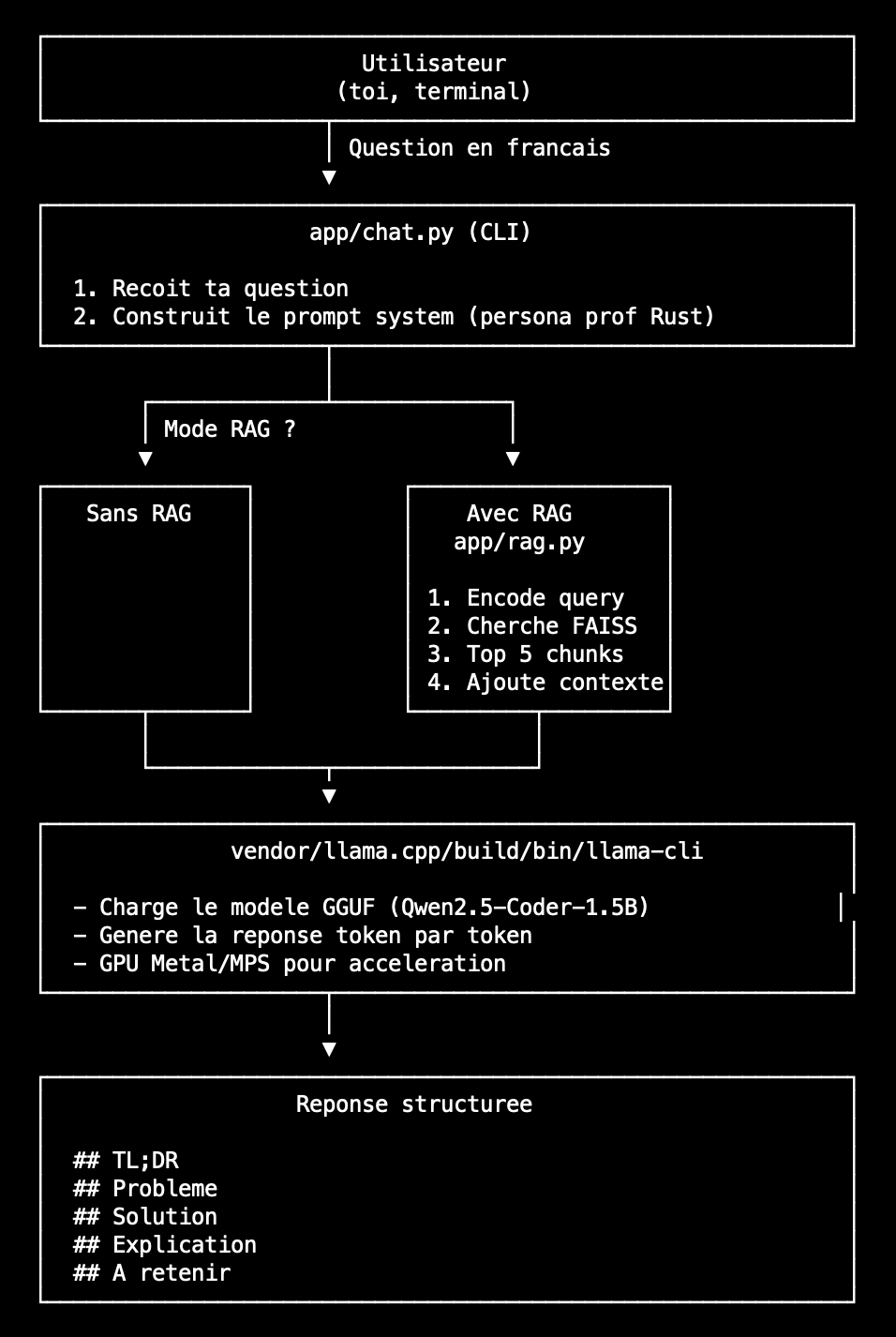
Pipeline: question → system prompt → optional RAG → llama.cpp → structured answer
Evaluation & Metrics
Rigorous evaluation protocol on 20 test prompts covering the key Rust concepts.
Overall metrics:
- Overall score: 3.07/5
- French accuracy: 95%
- Valid code blocks: 70%
- Compilation rate: 87%
Performance by category:
- Enums: 4.24/5 (best)
- Structs: 4.02/5
- Borrowing: 3.39/5
- Basics: 3.02/5
- Ownership: 2.54/5
- Lifetimes: 1.25/5 (to improve)
RAG impact:
- Without RAG: 3.05/5
- With RAG: 3.35/5
- Gain: +10% performance
Identified limitations:
- Advanced concepts (lifetimes, unsafe, async) less well handled
- Training dataset geared toward beginner/intermediate level
- Macros and complex patterns out of current scope
3.07/5
Score
87%
Compilation rate
95%
French accuracy
Enums 4.24
Best
1 / 2
RAG in action: explanation of ownership with sources from the Rust Book
Roadmap v2.0
Version 2.0 is under development with a major redesign of the user experience.
Web interface (in progress):
- Frontend: React + TypeScript + Tailwind CSS
- Backend: FastAPI for the REST API
- Modern UI with a dark theme
- Persistent conversation history
Planned improvements:
- Extended dataset with more advanced examples
- Reranking to improve RAG relevance
- Docker support for simplified deployment
- Human evaluation to refine the metrics
v2 quality goals:
- Overall score > 3.5/5
- Better lifetimes handling (goal > 2.5/5)
- Coverage of async/await concepts
- Complete user documentation
React + TS
Frontend
FastAPI
Backend
> 3.5/5
Goal
Docker
Deploy