AI Project2025
Space Coders Agency
AI-driven EdTech platform with a multi-agent architecture, designed to support learners and teaching teams.
LangGraphRAGMulti-agentLLMGDPREdTechMLOpsDesign ThinkingScrum
Needs & Design Thinking
Final project of the AI Project Manager program (Wild Code School / Iliad). As a Teacher Assistant, I observed the daily challenges of intensive digital training over several months.
Field issues identified:
• Trainers: 6-8h to create a quest (an Odyssey learning assignment), up to 12h for complex topics, ratio of 70% preparation / 30% support
• Learners: 1/3 feel behind, 1/4 are bored with standard exercises, demand for instant feedback
• Managers: late detection of students at risk of dropping out (week 8-10 out of 12), lack of objective metrics
Design Thinking approach in 5 phases:
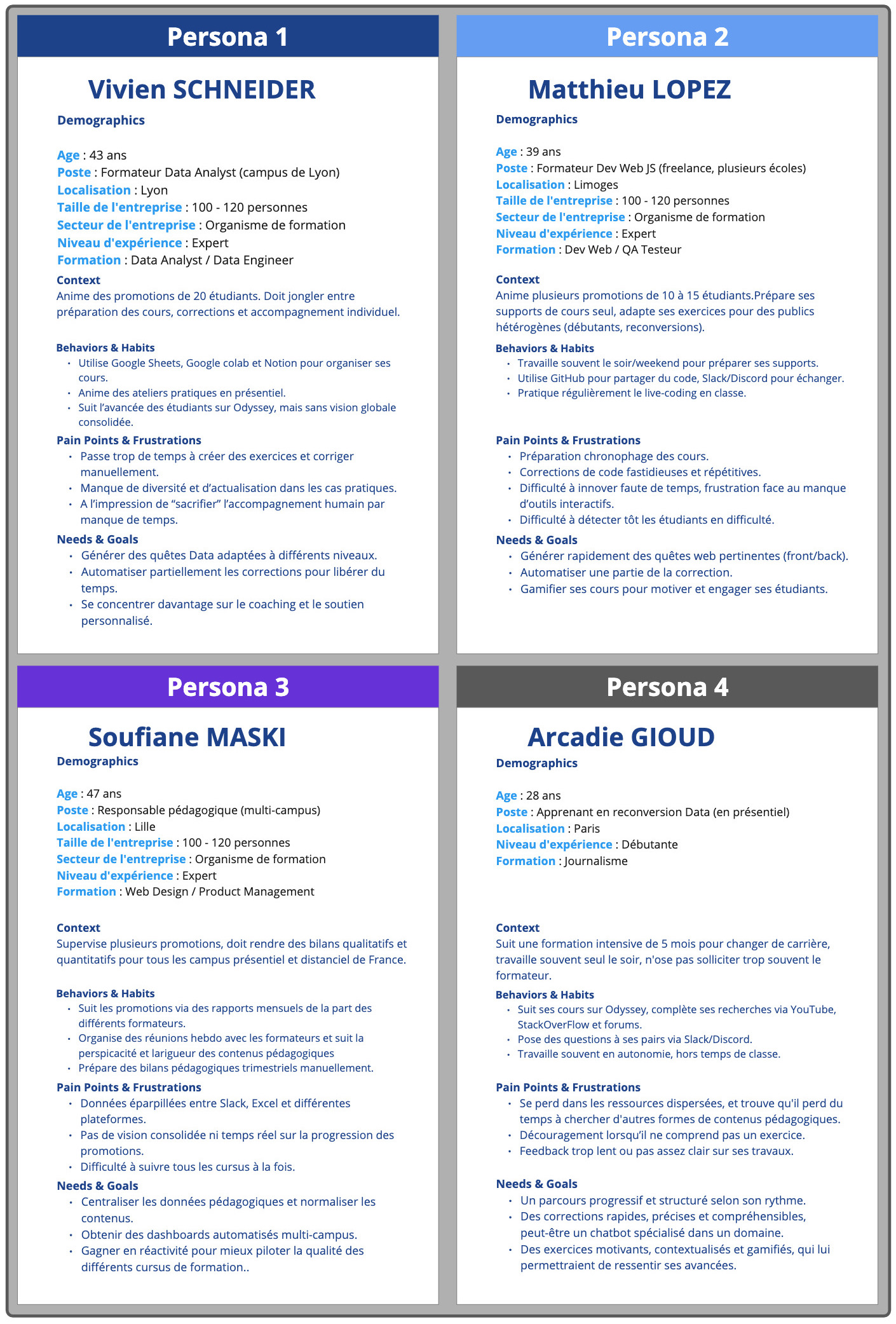
1. Empathy — Interviews with 8 trainers, 42 learners and 3 managers
2. Definition — Problem statement: "How can we automate the creation of personalized content while preserving human support?"
3. Ideation — Collaborative brainstorming on Miro with the Iliad team and trainers from the Lyon campus
4. Prototyping — MVP with 3 specialized agents tested on 5 real quests (JavaScript, React, Node.js, DevOps, databases)
5. Testing — Validation with 12 volunteer learners and 3 evaluating trainers
-85%
Creation time
8.1/10
Teaching quality
94%
RGAA compliance
92%
Satisfaction
1 / 5
Empathy phase: personas of learners, trainers and managers
Project Management
Development carried out fully independently over 7 months (March-October 2025) under strong constraints: the receivership of the Wild Code School ruled out any additional funding.
Hybrid methodology:
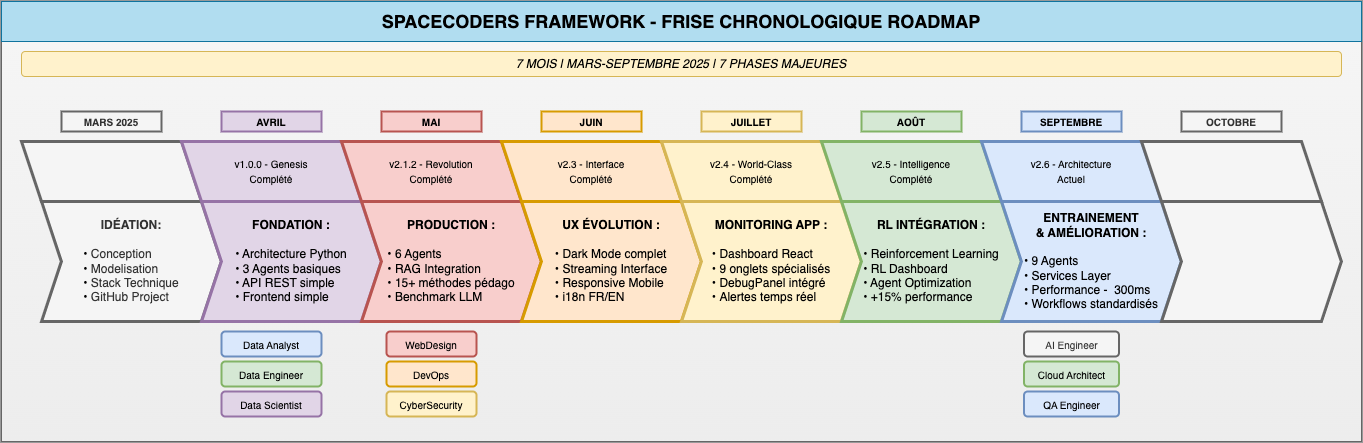
• Macro planning with PERT/Gantt — 6 phases: Foundations, Production, Monitoring, RL, Extension, Optimization
• Agile execution with adapted Scrum — weekly sprints, explicit Definition of Done, written daily stand-up
• 5 roles taken on in rotation: Project Manager, Data Engineer, Data Scientist, Architect, Frontend Developer
Tools and governance:
• GitHub Projects in Kanban mode (To Do → Ready → In Progress → In Review → Done)
• Monthly milestones (V1.0, V2.0...) aligned with the PERT milestones
• Risk-Driven Development: upfront risk identification, Probability × Impact matrix, mitigation plans
Custom monitoring application developed in parallel with 6 real-time dashboards: System (CPU, RAM, uptime), AI agents (latency, errors), RL (rewards, convergence), RAG (embedding quality), LLM benchmarks, Business (adoption, ROI).
7 months
Project duration
800h
Hours invested
€180
Actual budget
6
Dashboards
1 / 5
7-month roadmap: from design to optimization
Technical Implementation
Multi-agent architecture designed for scalability and maintainability, with local LLM execution to control costs and data confidentiality.
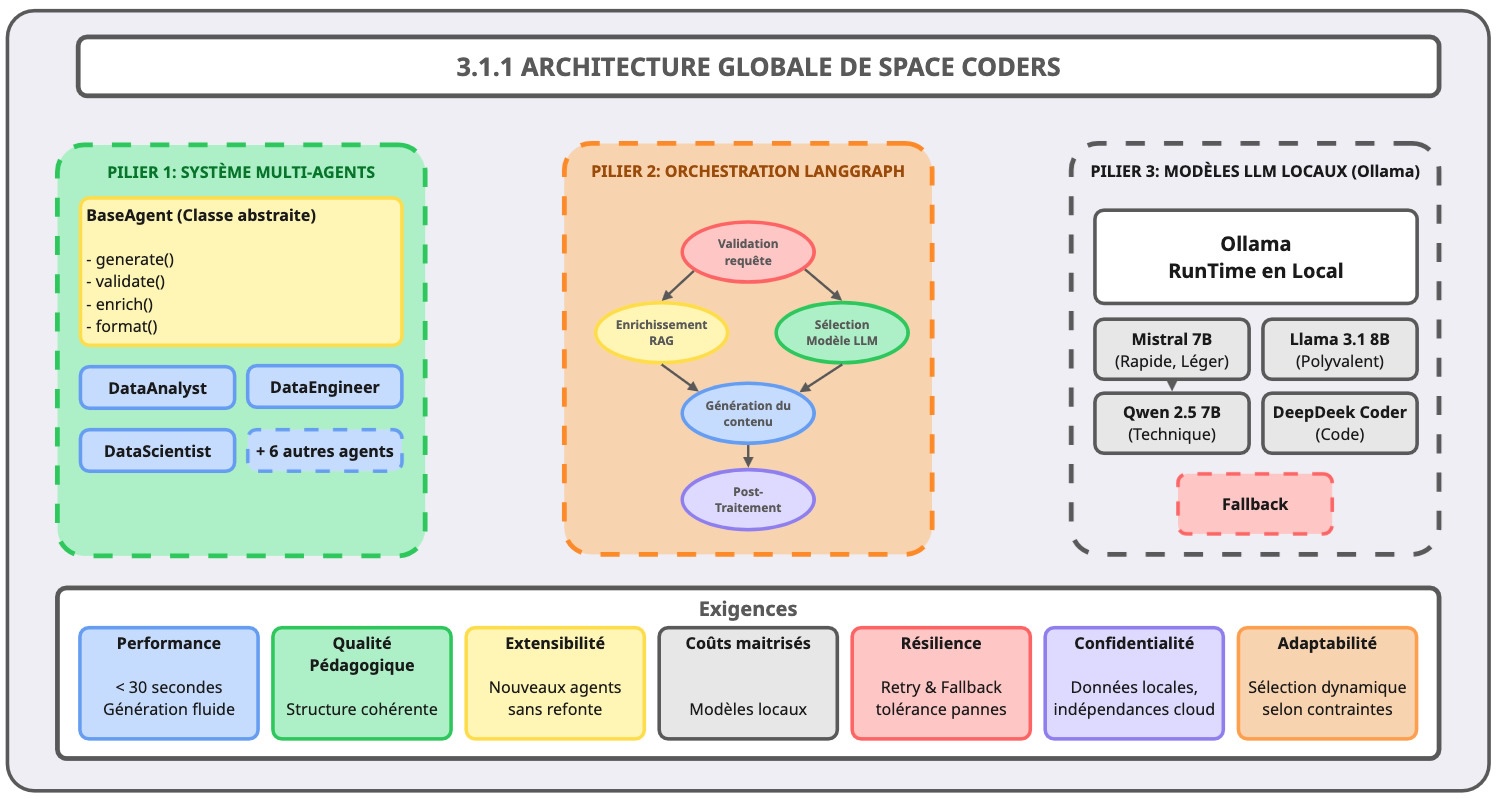
BaseAgent design pattern:
All agents inherit from a common abstract class that enforces a single contract: request validation, RAG enrichment, output formatting. Each agent adds its own specifics: tailored system prompt, business tools (Airflow DAG generation, model recommendations, etc.).
9 specialized agents: Data Analyst, Data Scientist, Data Engineer, AI Engineer, DevOps, Web Designer, Cybersecurity, QA Engineer, Cloud Architect.
LangGraph orchestration:
7-node workflow (validation → enrichment → model selection → generation → check → formatting → output) with automatic retry and fallback to an alternative model. Success rate >95%.
Hybrid RAG pipeline:
Dense search (all-MiniLM-L6-v2 embeddings) + sparse search (BM25) with MS MARCO reranking. Base of ~15,000 chunks. Redis cache with a TTL of 30 days.
Reinforcement Learning — From Q-Learning to LinUCB:
Tabular Q-Learning showed its limits (1,500 states, slow convergence, no generalization). LinUCB (contextual bandit) learns 3× faster, generalizes across similar situations, and uses 23× less memory.
9
Specialized agents
~12s
Average latency
<5ms
Cache HIT
87%
Optimal decisions
1 / 6
Space Coders architecture: agents, LangGraph workflow, local LLMs via Ollama
Deployment & Interface
Containerized infrastructure with full CI/CD, an accessible interface and regulatory compliance (GDPR, RGAA 4.1 — the French accessibility standard).
Infrastructure & CI/CD:
• Multi-service Docker Compose architecture with dependency orchestration
• GitHub Actions pipeline: lint, tests, build, automated deployment
• Built-in observability: structured logs, Prometheus metrics, alerts
User interface:
• React with a modular component architecture and optimized state management
• Native WCAG 2.1 / RGAA 4.1 accessibility: keyboard navigation, contrast, text alternatives
• Light/dark modes, internationalization (FR/EN)
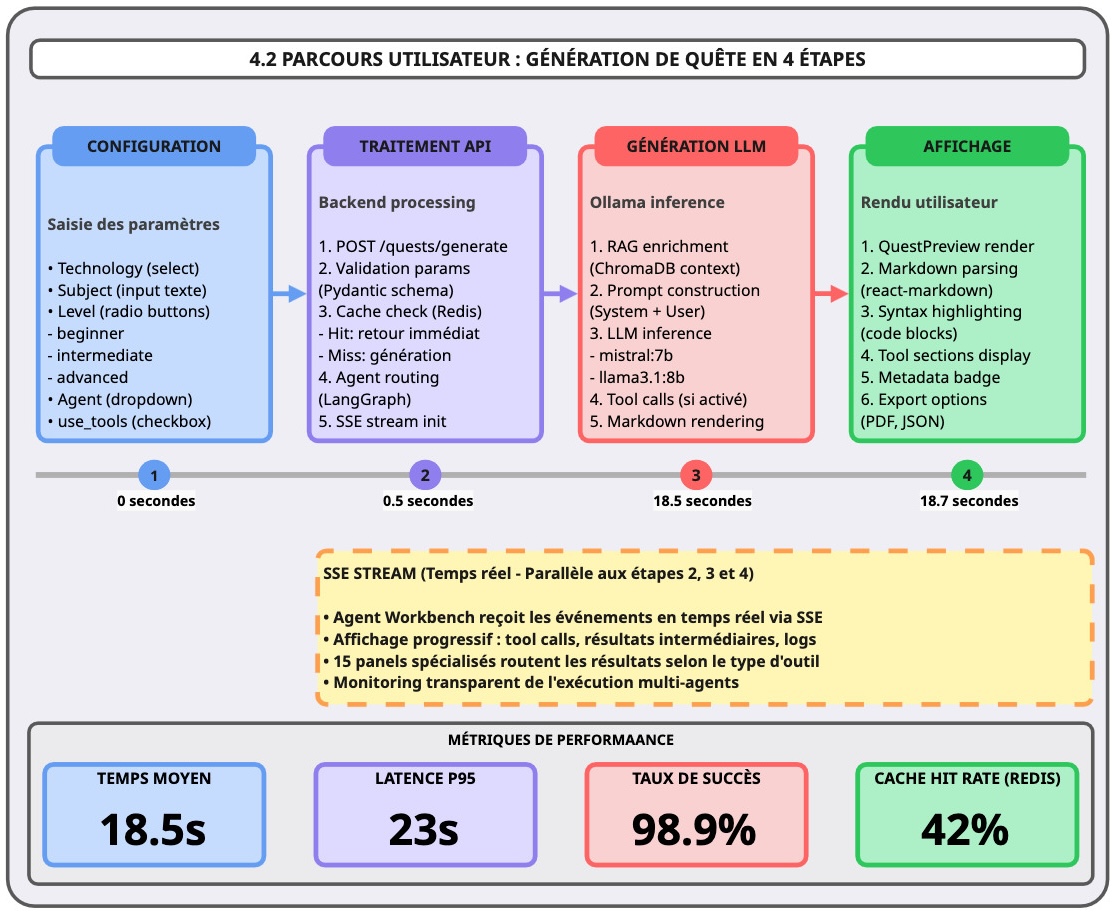
• Simplified UX journey: agent choice → topic → options → streaming generation (SSE)
Compliance & Quality:
• GDPR: record of processing activities, legal basis, data minimization, exercise of rights
• Cybersecurity: JWT authentication, RBAC, SCA scans in CI, CORS/CSRF/XSS protections
Rigorous A/B tests over 14 days (320 sessions) with random assignment stratified by level. Adaptive LinUCB vs static hyperparameters: significant improvement on all indicators (p<0.01).
+8.7%
Satisfaction
+6.2%
Completion
-13.4%
Time
94%
RGAA
1 / 6
UX flow: agent choice → technology → topic → options → streaming generation
Space Coders in Action
The final result: a complete platform for generating personalized learning quests, usable by Wild Code School trainers.
User journey:
1. Selection of the specialized agent (Data Engineer, DevOps, etc.)
2. Choice of technology from the catalog (50+ technologies available)
3. Configuration of options (level, duration, number of exercises)
4. Streaming generation with real-time display
5. Export and integration into Odyssey (the WCS learning platform)
The interface also includes a conversational chatbot to refine requests and a feedback system for continuous improvement through LinUCB.
50+
Technologies
9
Agents
~12s
Generation
92%
Satisfaction
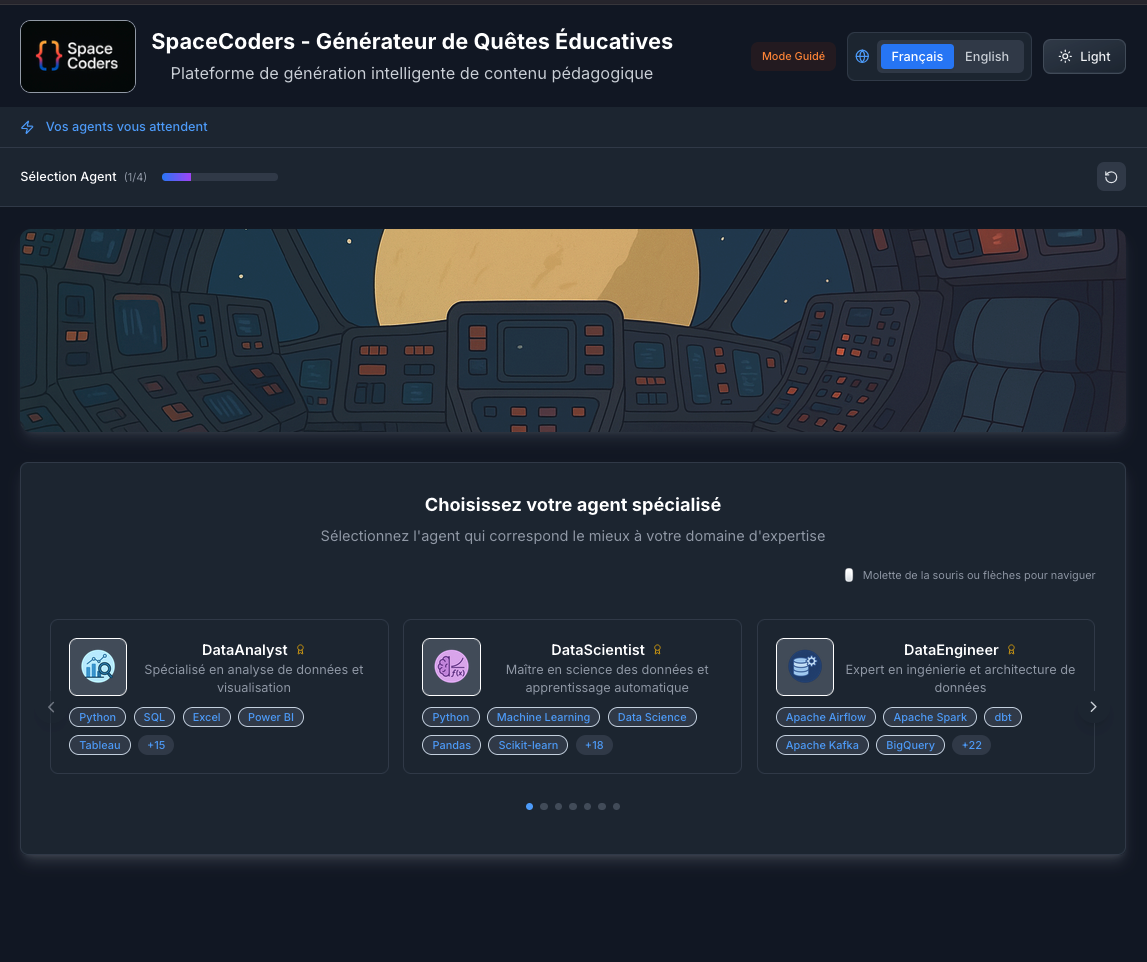
1 / 6
Main dashboard: agent selection and configuration